Why Do Two People With Similar Profiles Get Different Visa Decisions?
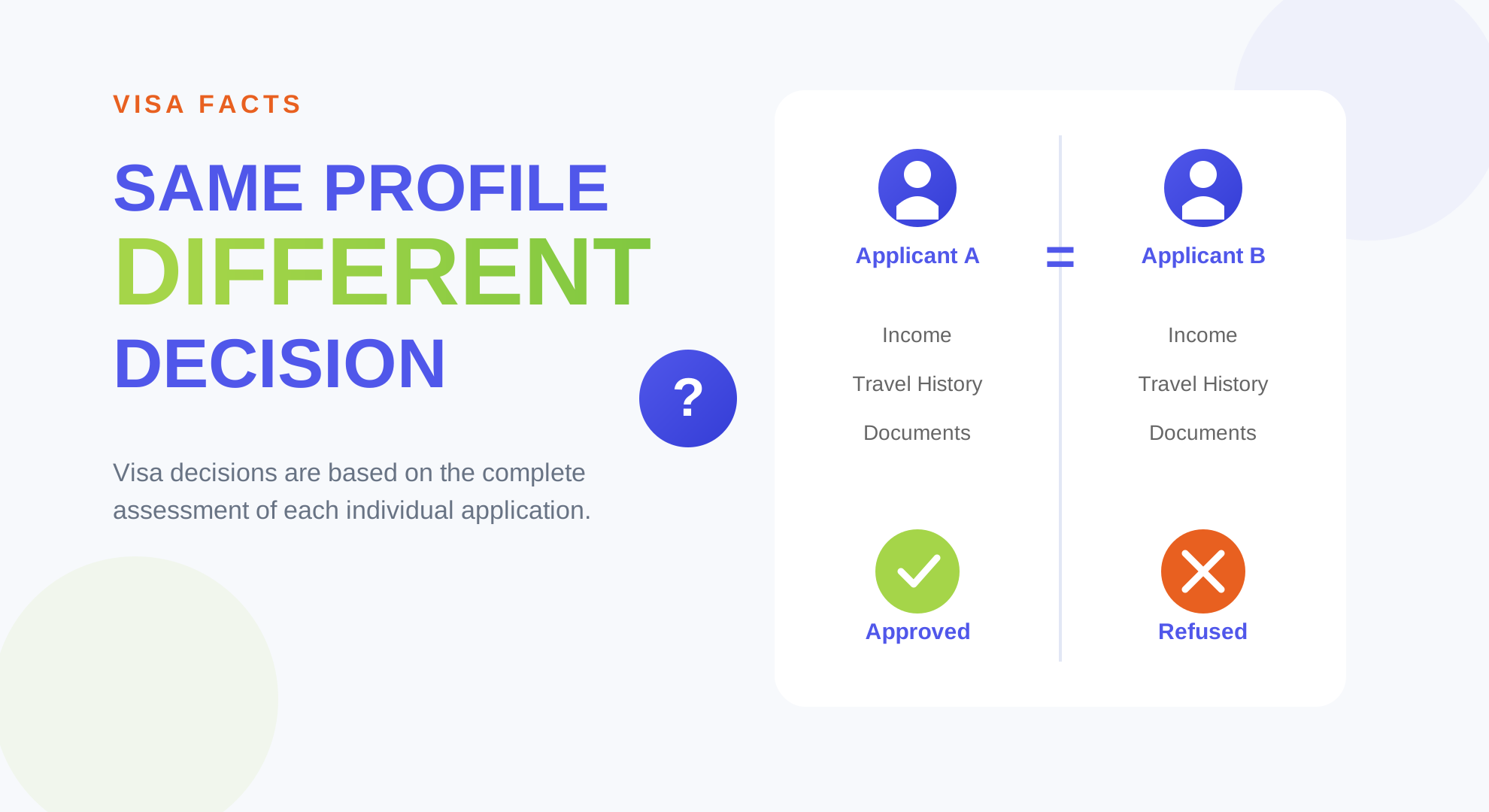
She is a software engineer with five years of experience, earning ₹18 lakhs per year, with a clean passport and a 12-day European tour planned. Her colleague across the hall has the same job title, the same salary, the same travel dates, and the same destination. Yet she received her visa in 12 days, while he was handed a refusal letter under Article 32(1)(b) of the Schengen Visa Code.
This scenario plays out every day in visa applications across the world. Two applicants with near-identical profiles approach the same embassy with the same purpose of travel — and walk away with completely different outcomes. It is confusing, frustrating, and often feels arbitrary. But is it really random? In this guide, we share practical visa application tips to help you understand and navigate these differences.
The short answer is no. Visa decisions are not random. They are the result of a systematic evaluation by consular officers trained to assess risk, intent, and credibility. Many applicants ask "why visa gets rejected" when their equally qualified friend was approved — the answer lies in subtle but critical differences that determine the outcome.
This comprehensive guide explores the hidden factors that cause different visa decisions for similar-looking profiles — and what you can do to ensure your application lands on the right side of the decision. Understanding common visa rejection reasons and avoiding visa application mistakes is the first step toward getting approved.
Key Insight: The "Similar Profile" Myth
On the surface, two applicants may appear identical: same profession, same income bracket, same destination, same travel dates. But consular officers evaluate over 40 distinct data points in every application. A difference in just two or three of these points can shift a decision from approval to rejection. This article reveals exactly which points matter most.
The Fallacy of "Similar Profiles"
When an applicant says "my friend with the same profile got the visa," they are often overlooking significant differences in how their applications were prepared and presented. Here is the truth: no two visa applications are truly identical, even when the applicants share the same demographic characteristics.
Consular officers across countries evaluate visa applications based on a standard risk assessment framework that considers:
- Financial credibility — Not just how much money an applicant has, but how they acquired it and whether it reflects genuine financial stability
- Immigration risk — The likelihood that an applicant will overstay or violate visa conditions
- Purpose credibility — Whether the stated reason for travel is supported by convincing evidence
- Compliance history — Past visa compliance, previous rejections, and travel behaviour
- Home country ties — The strength of an applicant's social, economic, and professional connections to their home country
Even when two applicants appear similar in income and occupation, each of these factors can be supported by vastly different documentation, leading to different outcomes.
For a broader understanding of the visa application process, read our Tourist Visa Consultant guide, which explains the step-by-step approach professional consultants use to prepare applications.
10 Hidden Factors That Cause Different Visa Decisions
Let us examine the specific factors that consular officers weigh — factors that can make two similar profiles produce completely different results.
1. Quality vs Quantity of Financial Documents
This is perhaps the single most common hidden factor. Two applicants with the same bank balance can receive different decisions based on how that balance was accumulated and presented.
| Factor | Applicant A (Approved) | Applicant B (Rejected) |
|---|---|---|
| Bank Balance | ₹5.2 lakhs with salary credits over 6 months | ₹4.8 lakhs deposited as one lump sum 2 weeks before application |
| Statement Pattern | Regular salary credits every month, gradual spending | Irregular deposits, large unexplained withdrawals |
| Income Proof | 6 months salary slips matching bank credits | Salary slips present but amounts do not match bank entries |
| Additional Assets | Fixed deposits, mutual fund statements, property documents | No additional asset documentation |
Consular officers are trained to recognise financial patterns. A large lump-sum deposit shortly before the application date is a red flag — it suggests the applicant borrowed money purely for the visa rather than demonstrating genuine financial capacity. On the other hand, a consistent salary credit pattern over 6 months shows stable income and genuine financial health.
2. Employment Stability & Income Consistency
Two applicants may both be "software engineers earning ₹18 lakhs," but one has been in the same job for 5 years while the other switched jobs 3 months ago. To a consular officer, these represent very different risk profiles.
Employment factors that matter:
- Job tenure — Longer tenure signals stability and stronger ties to the home country
- Company reputation — Employment at a well-known MNC or established firm adds credibility
- Leave approval letter — A proper letter with specific dates, sanctioning annual leave, confirms the employer expects you back
- Business ownership — Self-employed applicants need additional documents like business registration, GST returns, and IT returns
For a detailed checklist of documents required for various employment types, see our Visa Document Checklist 2026.
3. Travel History & Previous Visa Compliance
Travel history is one of the most powerful factors in visa assessments. It is also where similar profiles often diverge most significantly.
First-time Traveller vs Experienced Traveller
An applicant who has visited countries like UAE, Thailand, Singapore, or Malaysia and returned on time has already demonstrated compliance with visa conditions. A first-time international traveller has no such track record, making the assessment inherently riskier for the consular officer.
Schengen/US/UK/Australia Travel History
Previous travel to high-standard countries (Schengen states, USA, UK, Canada, Australia, Japan) carries even more weight. It proves you have already been vetted by a stringent immigration system and complied with its rules.
Visa Stamps vs Visa Stickers
Past visa stamps on your passport provide concrete proof of travel history. If your previous passport (with those stamps) is lost or expired, attach a copy of the old passport if available, or mention it in your cover letter.
4. Clarity of Purpose of Visit
"Tourism" is a broad description. A vague itinerary can undermine an otherwise strong application. Consular officers ask: Does this applicant genuinely know what they plan to do in my country? Does their itinerary make sense?
What makes a strong purpose statement:
- Day-by-day itinerary with specific attractions, restaurants, or activities planned
- Hotel bookings that match the itinerary (not just refundable cancellations)
- Internal flights or train bookings within the destination country
- A cover letter that tells a coherent story about why this trip matters to the applicant
What makes a weak purpose statement:
- Generic phrases like "sightseeing" or "tourism" with no details
- Hotel bookings from booking.com that are clearly cancellable with no genuine reservation
- An itinerary that does not account for travel time between cities
- A cover letter that reads like a template downloaded from the internet
5. Strength of Ties to Home Country
This is the cornerstone of visa risk assessment. The question every consular officer seeks to answer is: Will this applicant return to their home country?
Strong ties include:
- Permanent employment that expects your return
- Immediate family residing in the home country (spouse, children, elderly parents)
- Property ownership (home, land, vehicle)
- Ongoing education or professional commitments
- Business ownership or partnership in local ventures
Weak ties include:
- Unemployment or unstable job history
- No immediate family obligations
- Rental accommodation with no property assets
- Recently quit job or resigned from a position
6. Interview Performance
For countries that require a visa interview (USA, UK, Canada, Schengen in some cases), the interview can make or break an application. Two applicants with identical paper dossiers can receive different outcomes based purely on how they present themselves at the interview counter.
Interview factors that matter:
| Factor | Strong Applicant | Weak Applicant |
|---|---|---|
| Confidence | Answers clearly, maintains eye contact, does not fidget | Hesitates, gives vague answers, looks nervous |
| Consistency | Answers match documents exactly | Contradicts own application form or cover letter |
| Knowledge | Knows their itinerary, hotel names, and purpose clearly | Cannot name hotels or explain why they chose this destination |
| English Proficiency | Can communicate without an interpreter | Relies heavily on interpreter or struggles with basic questions |
| Return Intent | Confidently mentions job, family, or studies they are returning to | Vague about post-trip plans or says "I will see" |
For US visa interview guidance, read our US Visa Interview Tips 2026 guide, which covers preparation strategies applicable to most visa interviews.
7. Consular Officer Discretion (The Human Element)
This is the factor that feels most arbitrary, yet it follows a structured logic. Consular officers are experienced professionals trained to assess applications consistently. However, like all human decision-makers, they bring individual judgment, experience, and intuition to each case.
What influences officer discretion:
- Previous case experience — An officer who recently handled several fraudulent applications from a particular region or profession may scrutinise similar applications more closely
- Current immigration trends — If an embassy has seen a spike in overstays from a specific demographic, officers may apply stricter scrutiny
- Document presentation — A well-organised, neatly presented application with all documents properly arranged creates a positive impression
- The "gut feeling" — Based on years of experience, officers develop an intuition for identifying applications that do not feel genuine
While the human element exists, it is important to understand that officers follow standard operating procedures and visa codes. Discretion operates within boundaries, not outside them.
8. Application Timing & Seasonal Factors
The timing of an application can influence outcomes in subtle but measurable ways.
Peak Season vs Off-Season
During peak travel months (May–September for Schengen, November–January for Australia/NZ), embassies process higher volumes. While this does not change the criteria for approval, it can lead to longer processing times and, in some cases, more conservative decisions due to the volume pressure.
Application Timing Within Your Work History
A person applying immediately after starting a new job is riskier than someone who has been in the same role for years. Similarly, applying shortly after a large loan disbursement or while on notice period raises additional questions.
Application Submission Window
For Schengen visas, applying up to 6 months before travel is allowed. Applying exactly 6 months before (as soon as the window opens) versus 3 weeks before travel sends different signals about the applicant's planning and genuine intent.
9. Country-Specific Risk Assessment
Different countries have different risk profiles for different nationalities and regions. The same individual may be approved for a Thailand visa but rejected for a UK visa — not because the person changed, but because each country's immigration authority applies its own risk assessment.
For Indian applicants, the following general patterns have been observed in recent years:
| Destination | Typical Approval Rate (Indian Applicants) | Key Assessment Focus |
|---|---|---|
| Schengen Area | 75–85% | Financial credibility, travel history, purpose clarity |
| USA | 70–80% | Interview performance, home ties, previous travel |
| UK | 80–88% | Financial documents, purpose, compliance history |
| Canada | 75–85% | English proficiency, home ties, immigration intent |
| Australia | 80–90% | Employment stability, financial capacity, health insurance |
| Thailand/UAE | 90–95% | Basic financial proof, return ticket |
This explains why two people with similar profiles may succeed for some destinations but not others. For detailed processing times across different destinations, see our UK Visa Processing Times and Schengen Visa Complete Guide.
10. Document Presentation & Completeness
This is the most preventable factor. Two applications with identical information can receive different outcomes if one is incomplete, disorganised, or contains errors.
- All required documents from the official embassy checklist present
- Documents arranged in the order specified by the embassy or VAC
- Photocopies of all original documents (originals for verification at VAC)
- Self-attested copies where required
- Bank statements stamped by the bank (not just online printouts)
- Cover letter that is personalised, not a template
- Travel insurance meeting the minimum coverage requirements
- Correct visa category applied for (tourist, business, transit, etc.)
- Passport with sufficient validity (typically 6 months + 2 blank pages)
- Photographs meeting the exact size and background specifications
How Consular Officers Evaluate Applications
Understanding the evaluation framework helps demystify why similar profiles get different decisions. Most embassies use a structured assessment process that considers three core questions:
Is the Purpose Genuine?
The officer evaluates whether the stated purpose of travel (tourism, business, medical treatment, study) matches the visa category applied for and whether the supporting documents convincingly support this purpose. A tourist visa application with no hotel bookings, no itinerary, and a vague cover letter fails this test.
Can the Applicant Support Themselves?
The officer checks whether the applicant has sufficient funds to cover the entire trip — including accommodation, food, local transport, emergencies, and return travel. The required amount varies by country and duration, but the key is demonstrating how these funds were obtained, not just the final balance.
Will the Applicant Return?
This is the ultimate question. The officer weighs all evidence of home ties — employment, family, property, ongoing commitments — against any risk factors like weak financials, no travel history, or socio-economic conditions that might encourage overstaying. The decision is a risk calculation, not a certainty.
Real-World Case Studies
Case Study 1: The Same-Office Difference
Applicants: Two marketing managers at the same IT company, both earning ₹15 lakhs annually, both applying for Schengen tourism to Switzerland for 10 days.
Outcome: Applicant A approved, Applicant B rejected.
Why? Applicant A had been with the company for 4 years, provided 6 months of salary-slip-aligned bank statements with a ₹4 lakh consistent balance, a detailed day-by-day Switzerland itinerary, previous travel to Dubai and Thailand, and a cover letter explaining their 10th wedding anniversary celebration plan. Applicant B had joined the company 4 months ago, submitted bank statements with a ₹3 lakh lump-sum deposit made 10 days before the application, a generic "sightseeing" cover letter, no travel history, and no hotel bookings beyond the first night.
Case Study 2: The Bank Balance Trap
Applicants: Two business owners from the same city applying for US B1/B2 visas. Both have ITRs showing ₹25 lakhs annual income. Both have ₹8 lakhs in their bank accounts.
Outcome: Applicant A approved, Applicant B rejected.
Why? Applicant A's ₹8 lakhs balance had been maintained consistently for 8 months with regular business deposits and GST payments visible in the statement. Applicant B's ₹8 lakhs appeared as a single cash deposit 5 days before the application, and the officer noted that their ITR showed income of ₹25 lakhs but the bank statement showed almost no regular business transactions. The application was rejected for "insufficient evidence of financial means — source of funds not established."
How to Maximise Your Visa Approval Chances
The question "why visa gets rejected" often comes down to a few preventable issues. Based on the factors above, here is a practical action plan to maximise your visa approval chances:
- Plan ahead — start document preparation at least 3–4 months before your intended travel date
- Maintain a healthy bank balance with consistent salary/business credits for at least 3–6 months
- Avoid lump-sum deposits shortly before the application — let your money "age" in the account
- Build travel history gradually — start with easier destinations (Thailand, UAE, Singapore) before applying to stringent countries (Schengen, USA, UK)
- Prepare a detailed, genuine itinerary with confirmed (or at least refundable) bookings
- Write a personal, honest cover letter — do not use generic templates
- Ensure all documents are complete, self-attested, and arranged in order
- Attach additional assets — fixed deposits, mutual funds, property documents, shares
- If rejected, understand the exact reason before reapplying — do not simply re-submit the same application
- Consider consulting a professional visa agency for complex cases or after a rejection
Frequently Asked Questions
Because visa officers evaluate more than just job title and income. They assess the quality of financial documents (salary consistency, bank statement patterns, source of funds), employment stability (tenure with current employer, company reputation), travel history (previous visa compliance), home ties (family, property, ongoing commitments), and the clarity of the travel purpose. Even small differences in any of these factors can shift a decision. Additionally, the way documents are presented — completeness, organisation, personalisation — creates a different impression for each application.
Yes, significantly. Travel history is one of the strongest predictors of visa compliance. An applicant who has travelled to other countries and returned on time has already demonstrated that they respect immigration rules. For strict visa regimes (Schengen, USA, UK, Canada, Australia), previous travel to other countries is practically a prerequisite. First-time international travellers face higher scrutiny because they have no track record of compliance. For Indian applicants, starting with easier destinations like Thailand, UAE, Singapore, or Malaysia before applying to Schengen or the US substantially improves approval rates.
No. Consular officers are trained professionals who follow structured evaluation frameworks and legally defined visa codes. While each officer brings individual judgment and experience, their decisions are based on documented criteria, not personal mood. If you believe a decision was made in error, you have the right to request a review or reapply with stronger documentation. That said, the presentation of your application — how organised, complete, and convincing it is — does influence an officer's perception, which is why professional presentation matters.
The most common reasons for visa rejection among Indian applicants include: insufficient financial evidence (bank balance without proof of legitimate source), unclear purpose of visit (vague itinerary or missing details), weak ties to India (no stable employment, family, or property), previous visa violations or overstays, incomplete documentation (missing signatures, incorrect photograph specifications, expired passport), and poor interview performance (hesitant answers, contradictions with documents). For a detailed analysis of rejection reasons and how to address them, read our Schengen Visa Complete Guide.
You can self-assess your application by honestly answering these questions: Do I have 3–6 months of bank statements showing consistent salary or business credits? Do I have previous travel history where I returned on time? Do I have stable employment (1+ years with current employer)? Do I have a detailed itinerary with confirmed bookings? Is my cover letter personalised and genuine? Do I have additional proof of home ties (family, property, education)? If you answered "no" to two or more of these, consider strengthening your application before submitting. A professional visa consultant can provide a detailed pre-assessment.
Yes, it does. Most visa application forms ask whether you have ever been refused a visa for that country (or for any country, depending on the form). You must answer truthfully — hiding a previous rejection can lead to an automatic refusal and potentially a ban. However, a previous rejection does not mean you will be rejected again. If you understand why you were rejected and submit a stronger application that directly addresses the previous concerns, approval is still possible. For reapplying, it helps to show new evidence that was not present in the previous application — such as increased travel history, improved financials, or a different purpose of travel.
A professional visa consultant can improve your chances by ensuring your application is complete, correctly documented, and properly presented. They identify gaps in your documentation, help draft a convincing cover letter, advise on financial presentation, and guide interview preparation. While no one can guarantee a visa, a consultant significantly reduces the risk of rejection due to preventable errors. However, choose your consultant carefully — verify their credentials, check client reviews, and avoid anyone who promises guaranteed approval or suggests submitting false documents. See our guide on choosing a tourist visa consultant for a detailed selection checklist.
While the terms are often used interchangeably, there is a subtle difference. Visa refusal typically means the embassy formally processed and denied your application under a specific article of the visa code (e.g., Article 32(1)(b) of the Schengen Visa Code). Visa rejection is a broader term that includes both formal refusals and applications that are returned without being processed due to incomplete documentation or incorrect application. Both count as a negative outcome, and most visa forms will ask about both. The key is to read the formal decision letter carefully to understand the exact reason, as this determines your next steps.
This depends on the reason for rejection and your ability to address it. If the rejection was due to missing documents or an easily fixable issue, you can reapply immediately after gathering the correct documents. If the rejection was due to insufficient financial evidence or weak home ties, wait at least 3–6 months to build a stronger case — let your bank balance grow naturally, accumulate more travel history, or secure more stable employment before reapplying. Never reapply with the exact same documents and expect a different result. For Schengen visas, the visa code allows reapplying at any time, but we recommend addressing the rejection reason substantively first.
No. A high bank balance alone does not guarantee visa approval. What matters more is the consistency and source of those funds. A person with ₹3 lakhs in their account from 6 months of regular salary credits may be approved, while a person with ₹10 lakhs deposited as a lump sum a week before the application may be rejected. Additionally, the overall profile matters — employment stability, travel history, home ties, purpose clarity, and interview performance all play equally important roles. Visa decisions are holistic, not based on any single factor. For more on this topic, read our comprehensive Schengen Visa Bank Balance Guide.
Not Sure Why Your Visa Was Rejected?
Our visa experts can review your application, identify the hidden factors that led to rejection, and help you prepare a stronger case for reapplication. For personalised visa application tips and a detailed analysis of common visa rejection reasons, get in touch for a consultation today.
Get Expert HelpSources & References
Disclaimer: This article is for informational purposes only and does not constitute legal advice. Visa decisions are made at the sole discretion of the respective embassy or consulate based on applicable immigration laws and regulations. The factors discussed are general observations and may not apply to every case. Always refer to the official embassy website for the most current requirements and procedures.